Trading research
Regime Agent.
A research system for testing trading strategies with paper money. Strategy discovery and forward evaluation are kept separate.
Current report screenshots
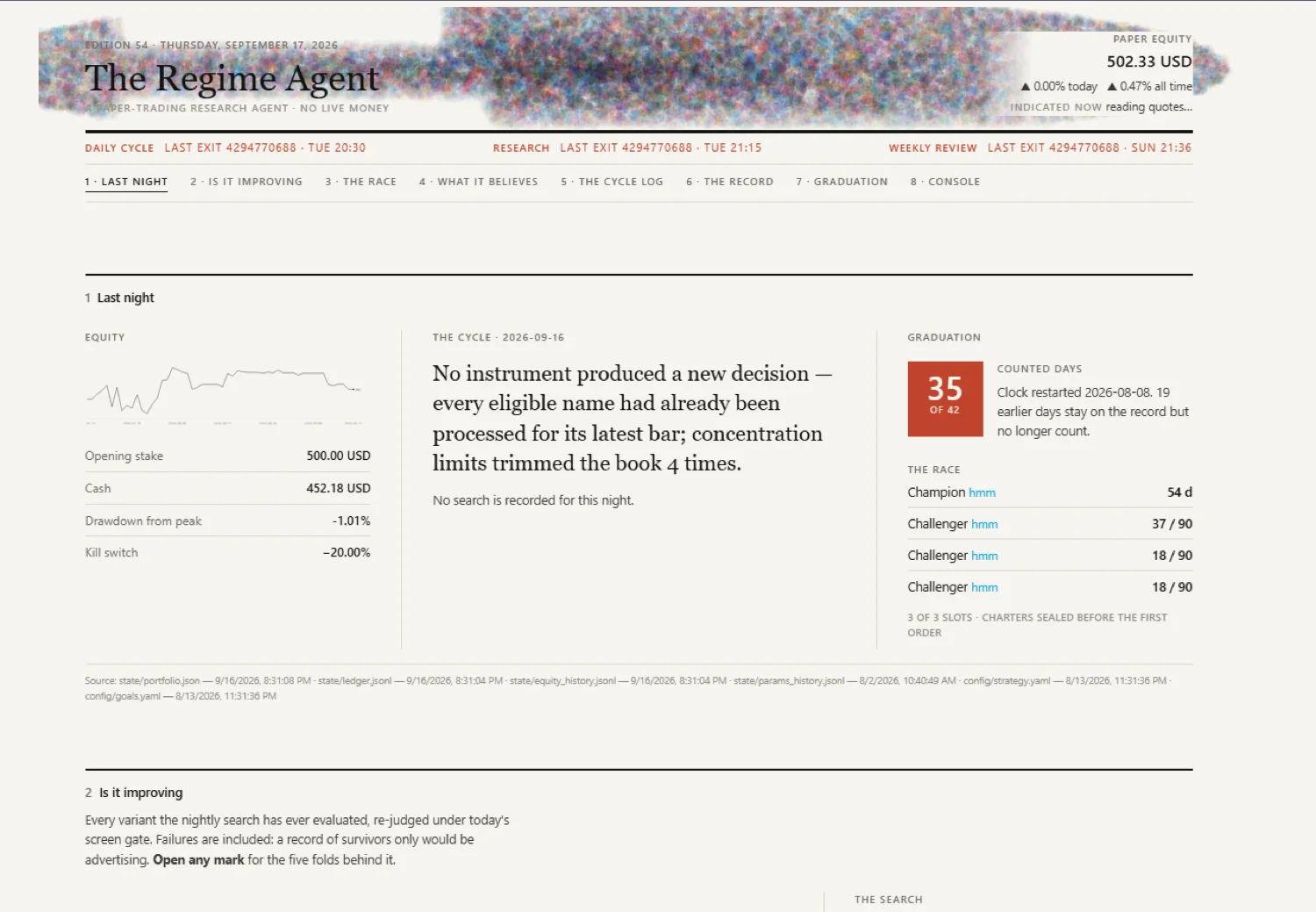
Why it was built
Backtests can make a strategy look convincing after many attempts have been tried. Regime Agent was built to keep those attempts visible, separate research from forward results, and require a published paper record before any real-money decision. Its report shows the failures, comparison bar and rule changes alongside the current candidate so a strong-looking chart is never the whole argument.
What it does
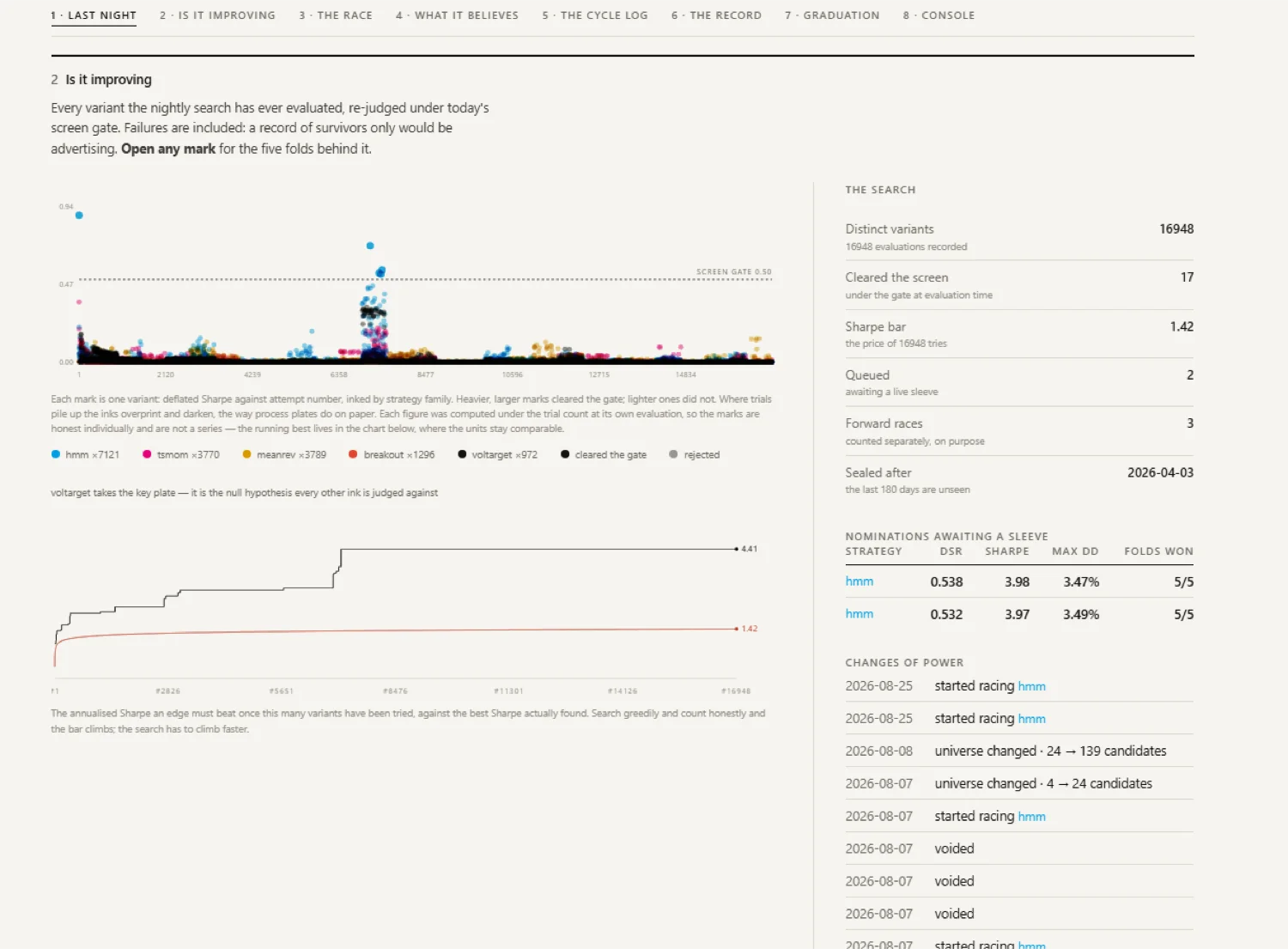
The coloured field across the report mast echoes the volume of trials behind a small set of decisions. The dense dots in Is it improving are the actual record: one mark per evaluated variant, including rejected attempts. Overlapping marks become darker where many similar results pile up. The crowding is intentional; a clean-looking handful of winners would make the search look more certain than it is.
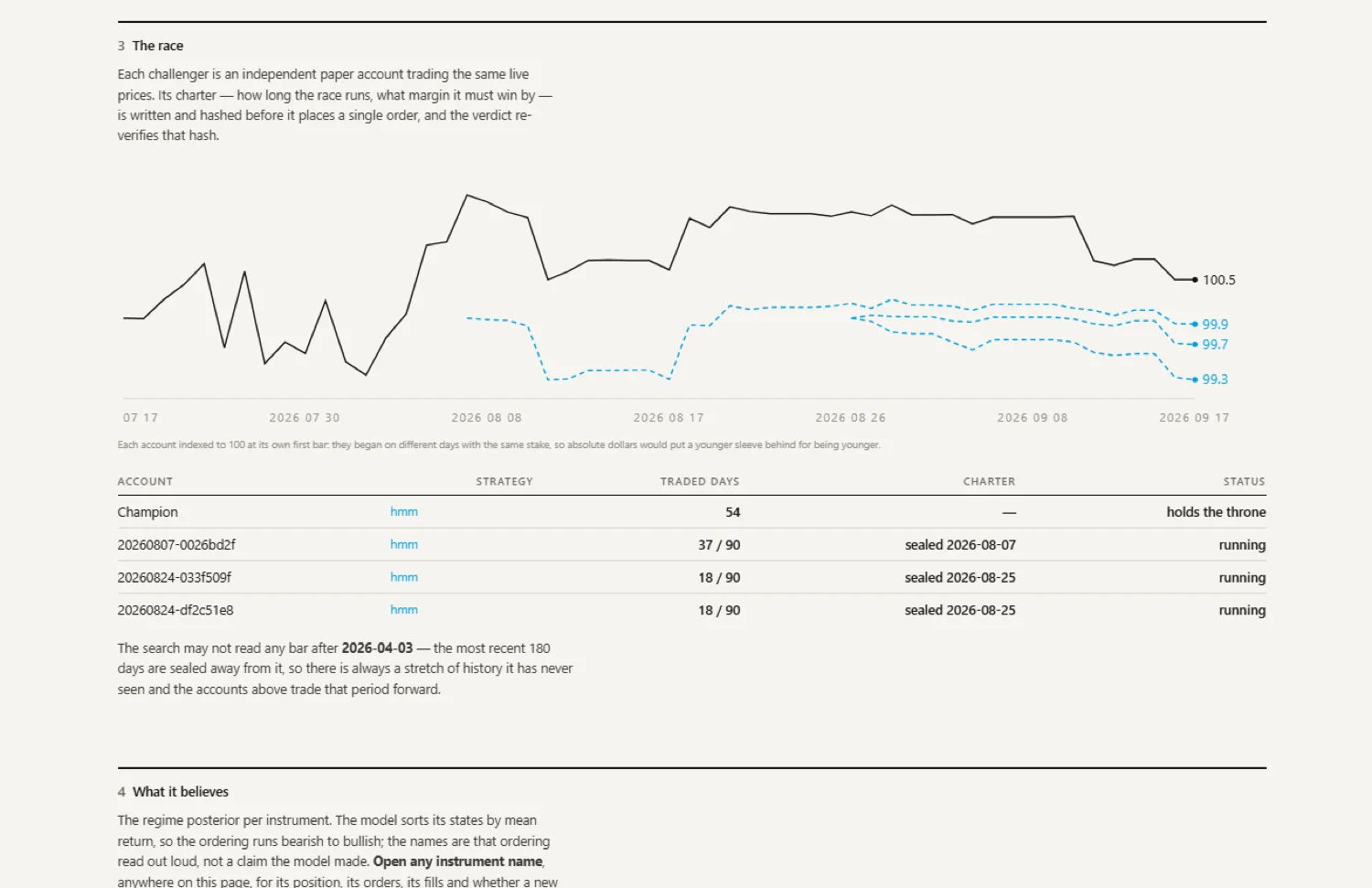
Every night it searches five families of strategy against a slice of market history that is sealed 180 days back: regime detection with a hidden Markov model, trend following, mean reversion, breakout, and volatility targeting, which is the do-nothing control made tradable. The search can only nominate. The claim that a strategy works is made forward, by live paper sleeves racing under charters that were hashed before the race began, on data the search has never seen.
The paper portfolio holds at most ten positions, limits exposure to any one sector and uses no leverage. The system checks more than a hundred instruments across sixteen sectors for eligibility each cycle.
A local dashboard and desktop window show the same record of tested strategies, accepted candidates and invalidated results, with reasons for each decision.
How it works
- The seal
- History is cut 180 days back and the search never sees past the cut. Anything found in the sealed slice has to prove itself on the days after it.
- Charters
- Before a challenger is seated it gets a charter: what it trades, how it sizes, when it is voided. The charter is hashed first, so nobody can quietly rewrite the rules after a good week.
- The race
- A champion and its challengers trade the same paper days side by side. A challenger has to beat the champion over a full ninety traded days to take the seat.
- The gate
- Forty-two counted paper days, a deflated Sharpe ratio at the target, drawdown under a fifth, all measured against simply holding the index. The count restarts from zero whenever the gate is found to have been softer than it should be, and it has restarted more than once.
- Eligibility
- Every instrument is checked each cycle and every exclusion gets a written reason, because an asset silently missing from a cycle looks exactly like one the signal declined to buy. That ambiguity once hid a data fault for twelve days.
- The lock
- The nightly cycle, the search and the weekly review queue behind one process lock so two jobs never write the same ledger at once.
Availability
This is a private paper-trading research project. Evaluation restarts when a defect is found in the qualification rules. A separate instance tests a higher volatility target and keeps its results in a separate record.
There is no public download. The system does not trade real money.